Wireless Vertical Mouse Honest Review — Is the Hype Justified?
I've been using a wireless vertical mouse as my daily driver for the past five months, and I wanted to share an honest, detailed account of what worked, what didn't, and whether the hype around these ergonomic devices is really justified. I bought mine to try to ease recurring wrist soreness and to see whether the trade-offs (size, learning curve, and sometimes higher price) were worth it for everyday productivity and occasional creative work.
Why I switched to a vertical mouse
Before this experiment, I used a conventional flat mouse for years. After a few weeks of intense spreadsheet work and photo editing, I started noticing a persistent ache at the base of my thumb and occasional stiffness in my forearm. A friend suggested trying a vertical mouse to encourage a more neutral wrist position, so I ordered one, planning to test it over several months.
My goals were simple: reduce wrist discomfort, avoid constantly adjusting my posture, and not sacrifice accuracy or speed for everyday tasks. I also wanted a wireless option with decent battery life and solid connectivity because my workspace is already cluttered with cables.
Design and build: first impressions
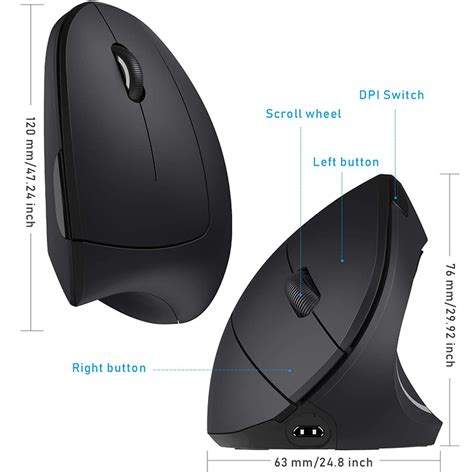
When I first unboxed the mouse, the most striking thing was the height and the tilted grip. The mouse tilts roughly between 55–65 degrees, which immediately forces your hand into a handshake position. That angle felt awkward at first — I had to consciously place my hand differently than I was used to — but the contours were generally comfortable. The shell is taller and a touch bulkier than my old flat mouse, which means it takes up more vertical real estate on the desk.
Build quality has been solid in my unit. The plastic feels dense and not overly glossy, and the matte coating resists fingerprints. The thumb rest is rubberized and textured, helping keep my hand from slipping during long sessions. One small detail I appreciated: there is a recessed compartment on the underside that stores the 2.4GHz USB dongle so you don't lose it — that saved me at least one mild panic moment when I was packing the laptop bag.
Ergonomics and comfort: did my wrist pain change?
After a week of awkwardness, I began to notice real differences. The biggest ergonomic win for me was the neutral wrist position. Instead of rotating my forearm inward (pronation) like I always did with a flat mouse, my hand stayed in a straighter alignment with the forearm. Within two weeks, the recurring ache at the base of my thumb diminished significantly.
There are trade-offs, though. Because the mouse is taller, I felt more strain in my shoulder and upper arm during the first few sessions; I suspect that's because I was unintentionally lifting my arm instead of moving my wrist/have subtle posture changes while adapting. Over several weeks I learned to move the whole forearm more efficiently, and the shoulder discomfort went away. In my experience, vertical mice require a short retraining period where you unlearn wrist-centric movements and adopt forearm-centric control.
Buttons, wheel, and controls: practical day-to-day use
The mouse has the usual array: left and right click, a notched scroll wheel, a DPI switch on top, and two thumb buttons for forward/back navigation. I use the thumb buttons constantly for web browsing and code navigation; they saved me time and reduced repetitive movements because I wasn't stretching to hit browser shortcut keys.
What I found was that the thumb button placement is a make-or-break detail. On my unit, the primary thumb button sits just where my thumb naturally rests, and the secondary one is slightly behind it. That placement made the primary button effortless and the secondary button slightly clumsy at first. If you rely heavily on the secondary button, you might find yourself accidentally pressing it or missing it depending on how large your hand is.
Discover deals on Electronics — updated daily.
View Offers →The scroll wheel is solid but noisy — it has a pronounced tactile click with each notch. I like the feedback for precision scrolling during editing, but if you’re in a quiet office and used to whisper-smooth wheels, this might be a minor annoyance.
Performance and tracking: accuracy, speed, and gaming?
Tracking has been reliable for my daily work. The optical sensor handled desk surfaces well — I used it on wood, a cloth desk pad, and a glass surface with a small mouse pad. I noticed occasional tiny jitters when making very slow, micro-adjusted movements (useful in photo retouching). For general office work, spreadsheet navigation, and web browsing, I didn't notice any meaningful loss of accuracy.
If you’re a gamer or you do precise pixel-level work, this mouse is not a gaming-grade option. The polling rate and DPI range are fine for casual gaming and general creative work, but I observed that in fast-paced FPS sessions my target tracking felt slightly less predictable than a high-end gaming mouse. I hardly ever game for long stretches, so that was acceptable for me, but I want to be clear: this mouse favors ergonomics over top-tier gaming performance.
Battery life and connectivity: what to expect
I used the mouse primarily in 2.4GHz dongle mode and occasionally via Bluetooth on my laptop. Battery life has been one of the best surprises. With moderate daily use (8–10 hours of office work, tabs of browsing, and a bit of editing), the internal rechargeable battery lasted about three weeks between charges. I charged it roughly once a month after a few months of use — battery degradation has been negligible so far.
The USB-C charging port is a small but important convenience. I was irritated at first that the mouse had to be oriented a certain way to charge comfortably whi…
Connectivity has been rock solid. Pairing via the dongle was plug-and-play, and Bluetooth pairing worked quickly with both a Windows laptop and a MacBook. I did once experience a brief bluetooth dropout when my phone and laptop were nearby and both connected, but reconnecting was fast and it didn't recur.
Software and customization
There is optional configuration software that lets you reassign the thumb buttons, adjust DPI stages, and set different profiles. I installed it on Windows to remap the second thumb button to a "middle-click" and to create a lower-DPI profile for photo editing. In my experience the software is functional but not elegant — it gets the job done, but the UI feels dated and a bit clunky. I prefer being able to do basic tweaks via hardware buttons without the software, and this mouse supports that for DPI switching and simple button use.
Real-world workflow: a typical day with the mouse
My typical day involves email, code, spreadsheets, occasional Photoshop edits, and a few Zoom meetings. I found the mouse to be excellent for clicking, dragging, and long scrolling sessions. After the initial adaptation period, I was less aware of hand position throughout the day — which is exactly what I wanted. One practical detail: I noticed I slowed down slightly when switching between the laptop trackpad and the vertical mouse. There’s a small context-switch penalty, so if you alternate frequently between the two, expect a brief readjustment each time.
Maintenance and durability
After five months of daily use, there are no visible creaks or wobble. The finish shows minor wear on the thumb rest from skin oils, but that’s cosmetic and cleans up with a damp cloth. The mouse foot glides remained smooth, and I didn't need to replace or deeply clean the sensor window. Overall it feels like it will last years with normal care.
Find top-rated Electronics products at great prices.
Browse Now →Pros & Cons
- Pros:
- I experienced clear relief from thumb-base wrist ache within a few weeks.
- Neutral wrist positioning reduced pronation-induced discomfort.
- Long battery life with rechargeable USB-C — charged about once every three weeks with heavy use.
- Solid tracking on most desk surfaces and a useful DPI switch for quick sensitivity changes.
- Thumb buttons that speed up browsing and development workflows.
- Cons:
- Initial learning curve: awkward and slower for the first several days to a week.
- Bulky footprint and taller profile can feel heavy or intrusive on smaller desks.
- Not ideal for high-frame-rate competitive gaming or very fine retouching work.
- Software is functional but unsophisticated; some advanced remapping feels missing.
- Scroll wheel is a little loud for quiet environments.
Comparison table: Vertical mouse vs. Flat mouse vs. Ergonomic trackball
| Vertical Mouse (wireless) | Flat Mouse (wireless) | Ergonomic Trackball | |
|---|---|---|---|
| Wrist posture | Neutral (reduced pronation) | Pronation common (higher wrist rotation) | Neutral; hand stays stationary |
| Learning curve | Moderate (days to weeks) | Minimal | High (weeks to adapt) |
| Precision (everyday use) | Good | Excellent | Excellent for fine control once learned |
| Gaming suitability | Casual gaming | Best for gaming | Not ideal for fast-paced gaming |
| Desk footprint | Large (taller profile) | Small | Small footprint but needs stationary space |
| Battery/connectivity | Often rechargeable, dongle/Bluetooth | Battery or rechargeable, dongle/Bluetooth | Typically rechargeable or wired |
| Best for | Office workers with wrist pain | Gamers, general users | Users needing minimal arm movement |
Buying guide: what to look for when shopping
If you're considering a wireless vertical mouse, here are the specific points I wish I'd looked at more closely before buying. These are based on things I noticed after months of use:
- Angle and size: The tilt angle (often 55–70°) determines how neutral your wrist will be. If you have a smaller hand, look for a more compact model; larger hands benefit from taller shells.
- Handedness: Most vertical mice are designed for right-handed users. If you're left-handed, check explicitly for left-handed models or ambidextrous designs.
- Connectivity options: Dual-mode (2.4GHz dongle + Bluetooth) is ideal. A dongle is more reliable for desks with many devices, while Bluetooth is convenient for laptops.
- Battery type: Rechargeable with USB-C is my preference. If a model uses AA batteries, check advertised battery life — it may be months, but swapping batteries is a hassle.
- Thumb button placement: This is crucial — if possible, try to test in-store how natural the thumb buttons feel. I misjudged this at first and had to adapt my workflow.
- Sensor specs: Look for a reliable optical sensor with adjustable DPI (800–4000+). If you do photo editing, a lower DPI stage for precision helps a lot.
- Build and materials: Thumb rests should be textured but comfortable — cheap rubber can degrade or become sticky over time.
- Return policy: Vertical mice have a personal fit aspect. Buy from a seller with a good return window so you can trial it at home for a couple of weeks.
Questions to ask yourself before buying
- Do I primarily use my mouse for office productivity or for gaming?
- Do I have desk space for a taller device?
- Am I willing to spend a week or two retraining my muscle memory?
- Do I need multiple device pairing (work laptop + personal laptop + tablet)?
Final verdict — is the hype justified?
After five months of using a wireless vertical mouse as my main pointing device, my answer is: mostly yes — but with caveats.
For me, the most important metric was comfort and reduction of pain, and on that front the vertical mouse delivered. I noticed significantly less wrist discomfort, and I no longer wake up with that dull ache at the base of my thumb after heavy workdays. The ergonomic benefits are real and noticeable if you suffer from pronation-related strain.
However, the experience comes with trade-offs. There's a learning curve, a bulkier profile, and compromises in very high-speed or ultra-precise tasks. The software could be better, and small details like scroll-wheel noise and button placement can either delight or frustrate depending on your preferences and hand size.
In my experience, if you struggle with wrist pain and your workflow is primarily office-focused (editing documents, spreadsheets, browsing, creative work that isn't pixel-level gaming), a wireless vertical mouse is worth trying. But do yourself a favor: buy from a retailer with a reasonable return policy, give yourself at least a week to adapt, and test thumb button placement and charging behavior during that trial period.
Personally, I kept mine, and it has become a comfortable, quiet companion for long workdays. I still keep a flat gaming mouse nearby for intense gaming sessions, but for everyday productivity the vertical mouse has been a clear net positive in my setup.
Conclusion
To summarize in plain terms: I was skeptical, then mildly annoyed by the adaptation period, and finally convinced. The ergonomics truly helped reduce wrist discomfort for me, and the wireless convenience, battery life, and solid tracking made it practical for daily use. If you're considering a switch to a vertical mouse, go in knowing there will be a short learning curve and that your mileage may vary depending on hand size and primary use. For my needs, the hype was justified — it improved my comfort without breaking my workflow.