Macbook Air M5 Specs, Features, and Value: Is it worth the price tag?
The MacBook Air M5 arrives as the next chapter in Apple's thin-and-light laptop line, promising improvements where many buyers expect them: sustained performance, better battery life, and incremental feature upgrades without sacrificing portability. This article breaks down what the MacBook Air M5 offers, how it performs in real-world scenarios, and whether it represents good value for different kinds of buyers. It covers design, display, performance, battery, ports, software experience, typical use cases, a clear pros & cons list, a comparison with recent predecessors, and a practical buying guide.
Introduction: Where the Air sits in 2026
The MacBook Air has long been Apple's answer for people who prioritize portability and battery life above raw workstation power. In this generation, the M5 chip—Apple's latest iteration of its custom silicon for consumer laptops—drives the new Air. Apple has historically balanced efficiency and performance gains with the Air's fanless design and compact chassis; the M5 continues that tradition while nudging performance and multimedia capability forward. For buyers, the key questions are: how much faster is the M5 than earlier chips, does the Air keep its portability advantages, and is the price increase (if any) matched by meaningful gains?
Detailed product review and analysis
Design and build quality
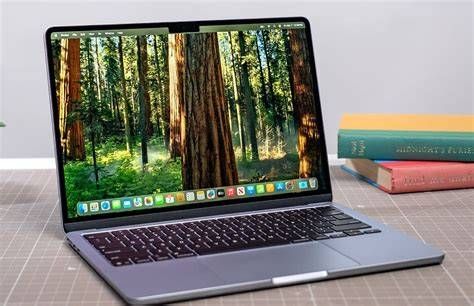
The MacBook Air M5 keeps the Air’s hallmark slim, wedge-free profile Apple stabilized in recent years. The chassis is thin and lightweight, using recycled aluminum and maintaining a premium matte finish. The hinge, keyboard deck, and trackpad retain Apple’s polished fit-and-finish. For travelers and students, the Air remains one of the lightest premium laptops—easy to tuck into a backpack or carry around campus all day.
Display
The Air M5 continues with a high-quality Retina-class display tailored for everyday productivity, media consumption, and light content creation. Expect a bright, color-accurate panel suitable for photo editing workflows at a hobbyist level and excellent text clarity for long reading sessions. Models are typically offered in a 13.x-inch size as the default; there may be larger variants for buyers who want more screen real estate while still staying thin and light. The display supports wide color gamut and True Tone-like color temperature adjustments for more natural visuals in varying lighting.
Performance and the M5 chip
The centerpiece of this generation is the M5 silicon. Apple’s incremental generational improvements typically include better single-threaded and multi-threaded CPU performance, improved GPU throughput, and neural engine enhancements for AI-related workloads. For day-to-day tasks—web browsing, document editing, video streaming, and light photo editing—the M5 delivers a noticeably snappier experience compared with earlier consumer chips. The M5 also handles more sustained workloads more gracefully than older MacBook Airs, particularly where background tasks and browser tabs accumulate.
For creative professionals doing photo edits, light video timelines, or vector work, the M5 provides a compelling balance: enough GPU acceleration to speed up rendering and export times while avoiding the heat and weight of heavier workstations. Heavier tasks like long-form 4K multi-cam video editing or large 3D renders remain better served by MacBook Pro-class machines with active cooling and higher-core configurations, but the M5 closes the gap for many prosumer workflows.
Find top-rated Laptops & Computers products at great prices.
View Offers →Thermals and sustained performance
Maintaining a fanless design is central to the Air's identity. The M5's efficiency improvements help it sustain higher clocks under light-to-moderate loads without throttling aggressively. Under extended heavy loads, thermal throttling is still present compared with actively cooled systems, but the Air's thermal profile is usually quieter and more comfortable for lap use. Buyers who need consistently high sustained CPU/GPU performance should consider MacBook Pro options with active cooling.
Battery life
Battery life is one of the Air's strongest selling points. The M5's efficiency gains translate into excellent battery longevity for typical mixed-use days—office productivity, video calls, and streaming. It remains a reliable choice for people who spend long periods away from outlets. Actual battery life varies with configuration, display brightness, and workload, but users can expect all-day usage in most mobile scenarios.
Ports, connectivity, and webcam
The MacBook Air M5 keeps a minimalist port selection: Thunderbolt/USB 4 ports, a headphone jack, and a MagSafe-style ch…Keyboard, trackpad, and user experience
The keyboard remains comfortable for long typing sessions with stable scissor-switch keys. Apple’s large Force Touch trackpad continues to be one of the best in the industry for precision gesture control. macOS optimizations, integration with Apple services, and ecosystem features (like Handoff, Universal Control, and continuity with iPhone/iPad) enhance everyday productivity and are a key part of the value proposition for buyers already invested in Apple’s ecosystem.
Storage and memory
The MacBook Air M5 uses Apple’s unified memory architecture, which typically improves real-world application responsiveness compared with traditional separate CPU/GPU memory pools. Buyers should consider higher memory configurations if they plan to keep many browser tabs, run virtual machines, or do heavier creative tasks. SSD performance remains excellent, with fast real-world file transfers and quick boot/resume times. Since storage is not user-upgradeable, choose the capacity that meets future needs.
Software and ecosystem
macOS continues to be a strong factor in the MacBook Air’s appeal. The M5 ships with the latest macOS at the time of purchase, optimized for Apple silicon, and benefits from years of software investment and app optimization. Third-party apps have increasingly native Apple silicon builds, which improves performance and stability. For users who rely on cross-platform tools or Windows-only software, virtualization or cloud alternatives should be evaluated—but for most mainstream users, the macOS app ecosystem is mature and capable.
Looking for the best Laptops & Computers deals on Amazon?
Shop Amazon →Real-world use cases
Understanding where the MacBook Air M5 shines helps set buying expectations:
- Students: The Air’s light weight, near all-day battery life, and bright screen make it ideal for lecture halls, study sessions, and note-taking. Fast wake and long battery mean fewer interruptions between classes.
- Knowledge workers and office users: Web-heavy workflows, spreadsheets, and video calls run smoothly. The Air is an excellent device for people who spend most of the day on browser-based apps and communications tools.
- Light creative work: Photo editing, podcasting, and short-form video editing are comfortable on the Air M5, particularly at hobbyist and prosumer levels. Exports are faster than previous Air generations but still not as fast as high-end MacBook Pros for large projects.
- Developers: The Air handles code editing, local servers, and many development tasks well. For large-scale local builds, additional memory and faster storage are recommended; developers who rely on heavy containerized workflows may prefer a Pro with more thermal headroom.
- Frequent travelers: Long battery life, light weight, and a solid build make the Air a reliable travel companion for digital nomads and business travelers.
Pros & Cons
- Pros:
- Excellent balance of performance and battery life for everyday tasks and light creative work.
- Thin, light, and premium build—very portable.
- Quiet, fanless operation for undistracted use.
- Strong macOS integration and optimized apps for Apple silicon.
- Meaningful efficiency gains versus older Intel-based Airs.
- Cons:
- Limited ports—may require dongles or a hub for multiple peripherals.
- Fanless design limits sustained heavy workloads compared with actively cooled laptops.
- Higher configurations can be costly; storage/memory are not user-upgradeable.
- Less suitable for professionals needing consistent workstation-class performance for long rendering sessions.
How the MacBook Air M5 compares to recent Air generations
| Model | Typical CPU/GPU Improvement | Max Unified Memory | Display | Battery (typical mixed use) | Weight | Starting price (approx.) |
|---|---|---|---|---|---|---|
| MacBook Air M5 | Incremental CPU + GPU gains vs previous generation; better NPU/AI acceleration | Configurable; choose more memory for multitasking | High-quality Retina / Liquid Retina-class; accurate color | All-day (real-world varies by use) | Very light (designed for portability) | Typically positioned in the premium thin-and-light bracket |
| MacBook Air M3 | Strong leap over M2 in efficiency/throughput for specific workloads | High, but less than top-tier Pro options | Excellent Retina display | Long battery life, slightly less than M5 in efficiency | Very light | Previously introduced at a competitive entry price |
| MacBook Air M2 | Solid performance at launch; first to reshape modern Air look | Moderate—sufficient for everyday users | High-quality Retina | Strong battery life | Very light | Entry-to-mid range for Apple ultraportables |
Interpreting the comparison
The comparison above is intentionally qualitative: Apple’s model updates tend to offer incremental speed and efficiency gains, with each new chip smoothing out real-world performance and enabling longer sustained workloads in a thin form factor. For most users upgrading from an M1 or Intel-based Air, the M5 will feel noticeably faster and more capable. Buyers coming from an M3 or M4-generation device will see smaller gains and should weigh whether those gains match the price of upgrading.
Buying guide: which configuration and who should buy
Choose the right configuration
- Memory: For general web, office work, and light content creation, a middle-tier memory configuration is fine. Choose more unified memory if heavy multitasking, many browser tabs, or virtual machines are part of the workflow. Because memory is soldered in, buy for future needs.
- Storage: Consider how long the laptop will be used and whether external drives will be part of the setup. For most users, a mid-range SSD is adequate. Content creators should opt for larger internal storage to avoid the performance hit of external drives during editing.
- Display size: If portability is the top priority, the smaller Air is ideal. If working with timelines, large spreadsheets, or dual-window productivity is common, consider a larger-screen variant or an external monitor.
- Ports: Plan for a USB-C hub or dock if multiple external devices are required (external displays, SD cards, Ethernet, multiple USB-A peripherals).
Who should buy the MacBook Air M5?
- Students, writers, and professionals who value portability and all-day battery life.
- Knowledge workers and remote employees who use collaboration tools, browsers, and productivity suites extensively.
- Light creative users who edit photos, produce podcasts, or create short videos and value a quiet, travel-friendly machine.
- Anyone embedded in Apple's ecosystem who benefits from device continuity and integration.
Who should consider alternatives?
- Professional video editors, 3D artists, or scientific compute users who frequently run sustained heavy workloads—these users should evaluate MacBook Pro models with active cooling and higher core counts.
- People who need many onboard ports without hubs; high-port ultrabooks or business laptops may suit them better.
- Windows or Linux-first developers who rely on specific tooling that runs better natively on other platforms might consider alternative laptops or dedicated workstations.
Practical buying tips and things buyers care about
Buyers often weigh the following when choosing a laptop; here is how the MacBook Air M5 addresses those concerns:
- Performance for price: Evaluate the baseline configuration for typical use: if the laptop will be used for everyday productivity, the base model is often the best value. If heavy multitasking or creative workloads are common, the upgraded memory and storage options are worth the investment.
- Longevity: Apple’s macOS and Apple silicon roadmap suggest multi-year software support and good resale value. Choosing a slightly higher configuration can extend the device’s useful life.
- Portability vs power: The Air prioritizes portability; consider whether a slightly heavier machine with active cooling is preferable if raw sustained power is required.
- Accessories: Factor in a protective sleeve, a USB-C hub for legacy peripherals, and possibly an external monitor for desk-focused productivity.
- Warranty and AppleCare: For users who prioritize device protection, AppleCare or equivalent coverage may be worth considering to protect against accidental damage and extend support.
Conclusion
The MacBook Air M5 is a refinement of Apple’s thin-and-light formula: a premium, highly portable laptop that brings measurable improvements in efficiency and day-to-day responsiveness. It is an excellent choice for students, knowledge workers, frequent travelers, and light creative professionals who value battery life, build quality, and the macOS ecosystem. Buyers who need workstation-level sustained performance should look to heavier MacBook Pro models, but for most everyday computing tasks the Air M5 strikes a sensible balance between performance, portability, and longevity. Ultimately, whether it is worth the price depends on how much the buyer values portability, battery life, and the Apple ecosystem—if those are priorities, the Air M5 is a compelling option that justifies its place in Apple’s laptop lineup.